
7 Mistakes You’re Making with Managed SOC Services (and How to Secure Your Indian Enterprise)

Too much information is often worse than no information at all. In the high-stakes landscape of Indian cybersecurity, many enterprises find themselves drowning in telemetry while remaining starved for actual security. As the regulatory environment tightens with the Digital Personal Data Protection (DPDP) Act and updated CERT-In mandates, the "set it and forget it" approach to a Managed Security Operations Center (SOC) is no longer just a technical oversight: it is a significant business liability.
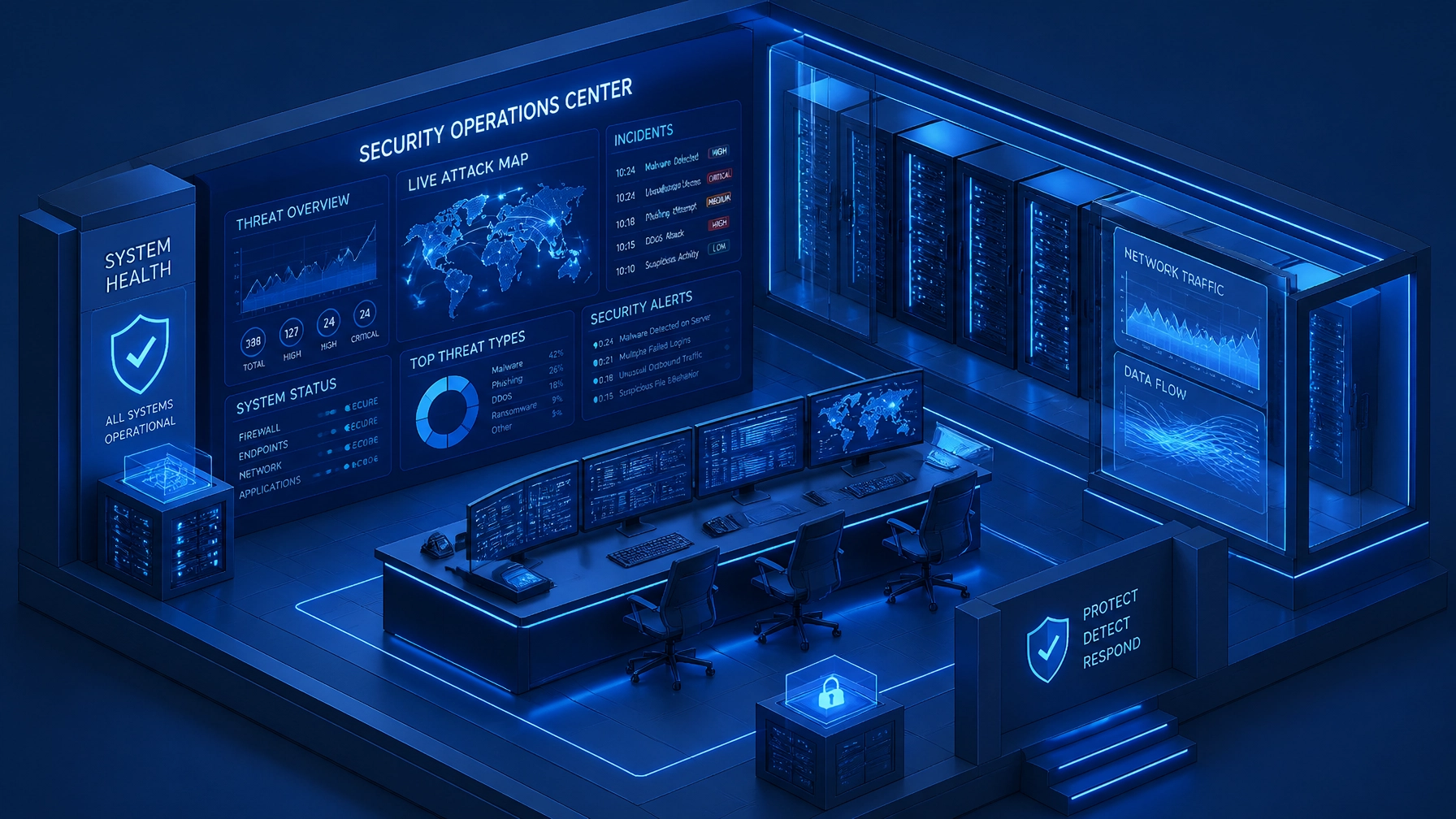
A Managed SOC is a centralized security function that leverages a third-party provider to monitor, detect, and respond to cyber threats across an organization’s entire digital footprint. While the promise of 24/7 vigilance is enticing, the execution often falters at the intersection of complex local regulations and legacy infrastructure.
At Fluke Infotech, we have observed that even the most robust IT infrastructure solutions in India can be compromised if the security layer is built on faulty assumptions. Below are the seven most critical mistakes Indian enterprises make with Managed SOC services and how to rectify them.
1. Treating the SOC as a Product, Not a Process
The most common fallacy is viewing a Managed SOC as a "black box" solution that provides security by simply existing. A SOC is not a software license; it is a dynamic process of continuous improvement.
The Mistake: Organizations often sign an SLA and assume their responsibility ends there. They treat the SOC provider as a vendor rather than a strategic partner.
The Solution: We advocate for a "Co-managed" mindset. Security posture is only as strong as the integration between your internal IT teams and the external SOC. This requires regular cadence meetings to tune detection rules based on your specific business logic, ensuring that the alerts generated are relevant to your actual threat profile.
2. Failing the CERT-In "6-Hour" Compliance Rule
The Indian Computer Emergency Response Team (CERT-In) mandates that certain cybersecurity incidents must be reported within six hours of being noticed.
The Mistake: Many enterprises rely on generic global SOC providers whose standard "High Priority" notification window is 24 hours. By the time you receive the alert, you are already in violation of national law.
The Solution: Your Managed SOC must have specific playbooks for Indian compliance. We ensure that our monitoring services are aligned with local reporting timelines, enabling your team to fulfill mandatory disclosure requirements without the frantic scramble that leads to incomplete reporting.

3. The "Data Hoarding" Trap vs. DPDP Data Minimization
With the DPDP Act now in play, the traditional "log everything forever" philosophy of security monitoring is a legal minefield.
The Mistake: Ingesting excessive personal data into your SIEM (Security Information and Event Management) tool "just in case" violates the principle of data minimization. If your SOC logs contain unmasked PII (Personally Identifiable Information) that isn't essential for threat detection, you are increasing your regulatory exposure.
The Solution: Implement sophisticated data filtering at the edge. We help clients classify their data flows before they reach the SOC, ensuring that only the telemetry necessary for security is stored, while sensitive personal data is either masked or excluded from long-term logs.
4. Overlooking Data Localization for Logs
Compliance is often a matter of geography. Under current Indian regulations, certain logs and incident records must be accessible and, in many cases, stored within the sovereign borders of India.
The Mistake: Utilizing a SOC provider that hosts your security data in overseas cloud regions without a local mirror or retrieval plan. This can lead to significant friction during a government audit or investigation.
The Solution: Partner with an integrator who understands the nuances of local cloud solutions. We emphasize architectures that maintain log residency in India, providing the necessary assurance for both CERT-In and the Data Protection Board.
5. Siloed Security: The SOC and SD-WAN Disconnect
Modern enterprises are increasingly adopting SD-WAN implementation to manage their distributed offices. However, security is often treated as a separate project from networking.
The Mistake: Running a Managed SOC that doesn't "see" what's happening inside your SD-WAN tunnels or at your branch locations. This visibility gap allows lateral movement of threats to go undetected.
The Solution: Security and networking must be converged. By integrating your SOC with your SD-WAN and SASE (Secure Access Service Edge) framework, we create a unified fabric where network anomalies are automatically correlated with security alerts. This holistic view is essential for protecting the modern "perimeter-less" enterprise.

6. Underestimating the Importance of "Physical" Infrastructure Security
It is easy to focus on cloud threats while ignoring the physical foundation of your IT environment.
The Mistake: Assuming the SOC only monitors digital traffic. If your server room in Mumbai or Noida has a temperature spike or unauthorized physical access, your SOC should know.
The Solution: A truly comprehensive Managed SOC integrates with environmental monitoring systems. Utilizing solutions like AKCP Monitoring Systems, we bridge the gap between physical and digital security. Additionally, ensuring your Structure Cabling Solution provider has implemented organized, secure cabling reduces the risk of physical tampering and accidental downtime.
7. Role Ambiguity: Data Fiduciary vs. Data Processor
In the eyes of the law, the responsibility for a data breach rarely falls on the vendor alone.
The Mistake: Assuming your MSSP (Managed Security Service Provider) will be legally liable for any breach. Under the DPDP Act, your organization is the "Data Fiduciary," and the SOC provider is the "Data Processor." You remain ultimately accountable for the safety of your users' data.
The Solution: Robust vendor governance is non-negotiable. We help our clients draft clear Data Processing Agreements (DPAs) that define exactly who is responsible for what during a breach: including who notifies the authorities and who manages the evidence trail.

The Fluke Infotech Advantage: Beyond Basic Monitoring
Securing an Indian enterprise in 2026 requires more than a dashboard and a few analysts. It requires a strategic partnership with a system integrator who understands the entire stack: from the Server Virtualization layer to the final fiber optic connection.
We provide:
- Tailored Security Architectures: We don't believe in one-size-fits-all security. Our solutions are mapped to your specific industry compliance needs.
- Strategic Vendor Partnerships: Our collaborations with Cisco, Fortinet, and Palo Alto Networks allow us to deploy world-class tools with local expertise.
- ISO 9001 Certified Processes: Our commitment to quality ensures that your system installation and ongoing support meet international standards.
- PAN India Support: Whether your operations are in Mumbai, Delhi, or remote industrial hubs, we provide comprehensive security assurance across the country.
Cybersecurity is not a destination; it is a state of perpetual readiness. By avoiding these seven common mistakes, Indian CIOs can move from a posture of reactive defense to one of proactive resilience.
Is your security infrastructure ready for the next decade of digital transformation? Contact us today to schedule a comprehensive security audit and discover how our Managed SOC services can be tailored to your enterprise's unique needs.